Describe the result, not just the material
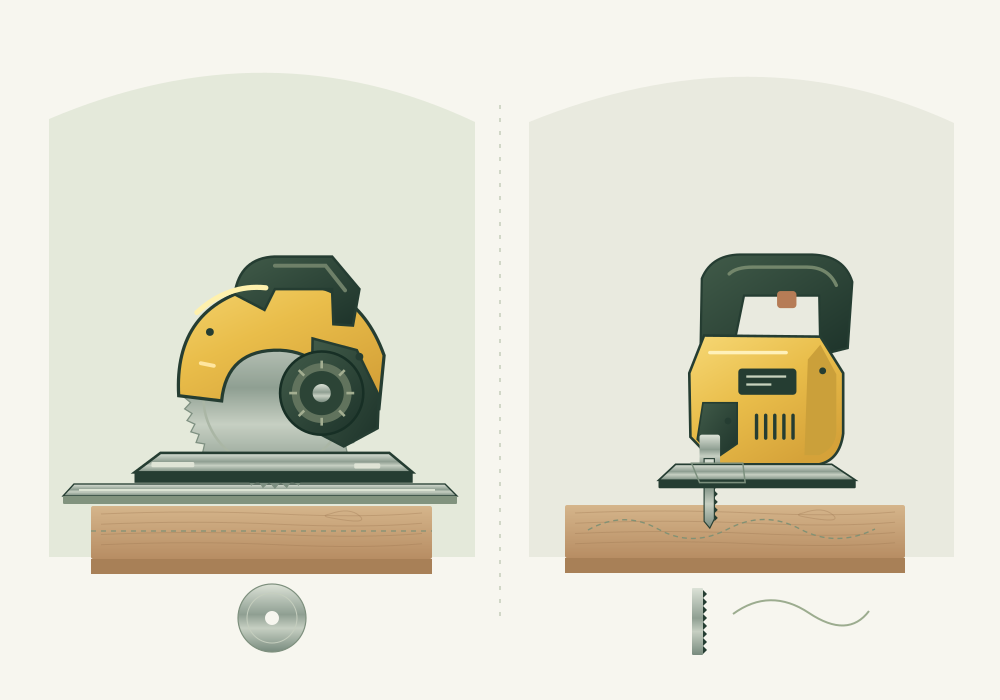
“Cutting wood” covers very different jobs. A long cut through a sheet, a short board cut and a curved opening may lead to different equipment. Note the size of the workpiece, the line you need to follow and which edge will remain visible. These details are more useful than starting with a general claim that one saw is more powerful.
Neither type guarantees a finished edge on its own. Material, blade choice, support and the tool’s condition all play a part. If a particular surface finish or accuracy matters, look for relevant evidence for that exact combination rather than assuming every saw in a category will produce it.
Include the blade and workspace in the decision
Treat the blade as part of the setup. Check the fitting and dimensions specified for the machine, the intended material and any other requirements in the instructions. A blade that physically appears to fit is not enough evidence of suitability. Do not assume that one blade is appropriate for every material on a project.
Portable does not mean a saw can be used anywhere. Plan how the workpiece will be supported, how much room the whole cut requires and how dust or debris will be managed. A modest machine in a suitable workspace can be a more useful purchase than a larger tool you have nowhere appropriate to use.
Buy for the cuts you are likely to repeat
If your projects mostly involve straight cuts in boards and panels, a circular saw is worth investigating before a jigsaw. If shaped work is central to the project, the jigsaw’s narrow blade makes its role clearer. Some workshops use both because the jobs are complementary, not because either tool is universally better.
For occasional work, include a suitable hand saw or a professional cutting service in the options. The answer does not have to be another power tool. Compare the cost of a complete usable setup, including blades, compatible guidance if needed, storage and support, against how often the equipment will genuinely be used.
Keep these in mind.
- Describe the cut before choosing a saw type.
- Include compatible blades, support and dust management.
- Do not treat tool type as a guarantee of finish or accuracy.
 chuck